Voice automation is moving from experimentation to actual deployment. A year or two ago, many companies still treated AI phone agents as a novelty. Now the conversation is more practical. Can an AI agent answer inbound calls without sounding robotic? Can it qualify leads, book appointments, route calls, and log outcomes into the systems a business already uses? Can it do all of that reliably enough to reduce pressure on human teams?
That is the context in which Synthflow AI has gained attention. Synthflow is a no-code platform for building AI voice agents that handle inbound and outbound phone calls. The company positions the product as a way for businesses to automate conversations, scheduling, support, and call workflows without needing to build custom voice infrastructure from scratch. Its documentation centers the product around a lifecycle it calls Build, Evaluate, Launch, and Learn, which reflects a more operational approach than the usual “type a prompt and hope it works” model.
This matters because businesses do not buy voice AI for the novelty of hearing a machine speak. They buy it because phone workflows are expensive, repetitive, and often fragmented. A company may have leads arriving through forms, ad campaigns, or referrals, then struggle to follow up fast enough. A clinic may lose bookings because front-desk staff cannot answer every call in time. A service business may spend too much human time on scheduling, qualification, and routine questions. Synthflow sits directly in that problem space.
So this Synthflow AI review looks at the platform from that practical angle. What does it do, how does it work, where does it fit, and what should businesses know before they take it seriously?
Key Takeaways
- Synthflow AI is a no-code platform for building AI voice agents that automate inbound and outbound phone conversations.
- The product is strongest in structured business workflows such as appointment booking, lead qualification, call routing, and connected follow-up actions.
- Its practical appeal comes from integrations with telephony systems, CRMs, automation tools, and calendars rather than from voice generation alone.
- Current official pricing is centered on a Pay As You Go model and custom Enterprise plans, which makes the platform more operational than consumer-grade.
- The best fit is a business where phone conversations are high-value and repetitive enough that automation can save meaningful time or capture more opportunities.
Table of Contents
What Is Synthflow AI?
Synthflow AI is a platform for building conversational AI voice agents that can answer and place phone calls. The official product documentation describes it as a system that helps businesses automate conversations across both inbound and outbound call scenarios, with agents that can answer questions, engage customers, and streamline operations. The company also emphasizes that the platform is no-code, which lowers the barrier for teams that want to deploy voice automation without a traditional engineering build-out.
The product is not limited to one narrow workflow. Synthflow’s documentation and integrations point to several categories of use. It can support appointment scheduling through real-time booking integrations, connect to telephony systems through Twilio or SIP/PBX setups, and tie call outcomes into automation tools such as Zapier and Make. It also integrates with business systems such as HubSpot, GoHighLevel, Stripe, Cal.com, and ElevenLabs. That breadth matters because AI phone agents are only useful when they can actually do something during or after the call.
The broader market seems to agree that voice AI is becoming serious. In 2025, Business Insider reported that Synthflow raised a $20 million Series A, bringing total funding to $30 million. The company said it served more than 1,000 enterprise clients and highlighted use cases across finance, healthcare, and education. That does not automatically make it the best product in the category, but it does show that Synthflow is not a small side project trying to ride an AI wave. It is being built as infrastructure for business phone automation.
Why AI Voice Agents Are Transforming Call Centers
The old model of phone automation was the IVR maze. Press one for sales. Press two for support. Press three to repeat everything you already told the company on the previous call. It was functional, but rarely pleasant.
Voice AI is trying to replace that with something closer to conversation. Synthflow’s pitch is built around that replacement. The company says its agents can have real-time contextual conversations rather than relying on rigid menu trees. Business Insider reported that the company positions its response time at under 400 milliseconds, which it compares to human conversational speed. Whether every call feels truly human is a different question, but the strategic aim is clear. The platform is trying to make phone automation feel less like a script and more like dialogue.
That shift matters because call centers and service teams are under pressure from both sides. Customer expectations have risen, but labor-intensive phone operations remain expensive. Companies want more availability, faster response times, and better call handling without adding headcount indefinitely. AI voice agents offer one route to that outcome, especially for repetitive workflows such as booking, routing, qualification, reminders, and simple support questions. Synthflow’s own integrations around booking, workflow automation, and CRM syncing suggest that it is being designed for exactly these kinds of operational tasks.
For marketers and growth teams, the angle is slightly different. Voice agents are not just support infrastructure. They can also become part of conversion infrastructure. A lead form can trigger an outbound AI call. An inbound inquiry can be qualified instantly. A missed opportunity can be followed up automatically. In that sense, voice AI starts to look less like customer support software and more like an extension of lead generation and funnel management.
How Synthflow AI Works
The platform’s own documentation frames the lifecycle around four stages: Build, Evaluate, Launch, and Learn. That is useful because it shows Synthflow is not only about creating a voice bot. It is trying to make deployment operational and repeatable.
Step 1: Designing the Conversation Flow
The first stage is building the agent. According to the docs, this includes defining logic, shaping behavior, connecting tools, and using a call flow designer. In practical terms, that means deciding what the agent should do on a call. Is it booking an appointment, qualifying a prospect, answering common questions, or routing to a human? That design work matters more than many teams assume. A voice agent is only as useful as the workflow behind it.
If a business wants to automate appointment scheduling, for example, it needs a clear path. The agent must ask for preferences, check calendar availability, present options, confirm the slot, and trigger a follow-up. Synthflow explicitly documents this with its Real-Time Booking Node, which supports appointment scheduling during live calls and can connect to platforms such as Cal.com and Google Calendar-related booking workflows.
Step 2: Training the AI Agent
The product documentation also refers to knowledge bases, voices, and actions as parts of the build process. In practice, this is where businesses shape what the agent knows and how it responds. The goal is not just to have a voice that sounds acceptable. It is to make sure the agent has the right information and enough structure to handle common call scenarios well.
This is one of the key differences between a demo-grade AI voice bot and a production-grade one. A real business deployment needs more than conversational polish. It needs reliable boundaries, correct business information, clear escalation paths, and integration with real systems.
Step 3: Connecting Telephony and CRM Systems
A voice agent is not useful if it lives in isolation. Synthflow supports several deployment paths. A team can use a test number, bring its own Twilio account, or connect an existing phone system through SIP/PBX on the enterprise plan. The docs specifically mention integration with SIP providers and PBX environments such as 3CX, Asterisk, Cisco, Avaya, and Genesys-related setups.
On the workflow side, the platform connects to Zapier and Make, which allows businesses to trigger calls, sync call data, update CRMs, and launch broader automations. It also supports integrations with systems such as HubSpot and GoHighLevel. This is important because phone conversations are rarely the whole job. Usually the business also needs to log the result, update a record, trigger a follow-up, or notify a team member.
Step 4: Deploying and Monitoring the Agent
After build and integration comes deployment. Synthflow’s framework explicitly includes evaluation and learning, which suggests the company expects teams to simulate, monitor, and iterate rather than push agents live and leave them alone. That is encouraging. Voice AI is too sensitive to edge cases for a “set it and forget it” mindset. A business needs to listen to what happens on actual calls, watch failure points, and tighten the flow over time.
Key Features of Synthflow AI
No-Code Voice Agent Builder
This is one of the platform’s clearest selling points. Synthflow repeatedly frames the product as no-code, which opens it up to operations teams, agencies, service businesses, and marketers who do not want to build voice systems from APIs upward. That matters because many voice AI competitors still assume a more technical user.
Enterprise Telephony Flexibility
The official telephony and SIP documentation is a real strength. Many AI startups talk about automation but are vague about how they fit into existing phone systems. Synthflow is more explicit. It supports using purchased test numbers, Twilio-based setups, or SIP/PBX connections for enterprise environments. That gives businesses a path from trial deployment to deeper operational integration.
Workflow Automation Through Integrations
The Zapier and Make documentation shows that Synthflow is not just a call-answering layer. It can be connected to broader no-code workflows, which allows businesses to trigger outbound calls, sync call results, and pass data into CRMs or other operational tools. That is often where the real value appears. The conversation itself matters, but the downstream action matters just as much.
Real-Time Booking and Action Handling
Appointment scheduling is one of the strongest practical use cases. Synthflow documents a booking flow that can check availability, propose slots, confirm appointments, and send confirmation details during the call itself. For clinics, agencies, home services businesses, and sales teams that rely on booked conversations, this is a meaningful feature rather than a decorative one.
Broad Integration Ecosystem
The integrations overview mentions HubSpot, GoHighLevel, Twilio, SIP, ElevenLabs, Cal.com, Stripe, Bubble, Zapier, Make, and Azure OpenAI support. That mix suggests Synthflow is aiming to be used in real business stacks rather than in isolated demos.
Who Should Use Synthflow AI?
Synthflow is not for every business, and saying otherwise would turn this into a soft product brochure. It makes the most sense in environments where phone conversations are frequent, structured enough to automate, and valuable enough to justify operational setup.
For service businesses that live on inbound calls, the platform has a clear case. If the business loses leads because staff cannot answer quickly enough, an AI voice agent can cover the first layer of response, qualification, and scheduling.
For appointment-heavy organizations such as clinics, agencies, or consultative businesses, the real-time booking workflow is particularly relevant. If the business spends too much human time on repetitive scheduling, Synthflow can potentially remove a large chunk of that load.
For sales and lead-generation teams, the use case is different but equally practical. An AI voice agent can follow up on leads, ask qualification questions, route strong prospects, and log outcomes into connected systems. When businesses care about response speed, this can matter a great deal.
For agencies, there is another angle. Third-party sources and the docs point to agency and white-label styles of use, which suggests that some firms are packaging voice automation for clients rather than only for internal operations.
For a very small business with low call volume and no need for structured automation, however, the platform may be overkill. The tool starts making more sense when calls are operationally important, recurring, and expensive to handle manually.
Synthflow AI Pricing
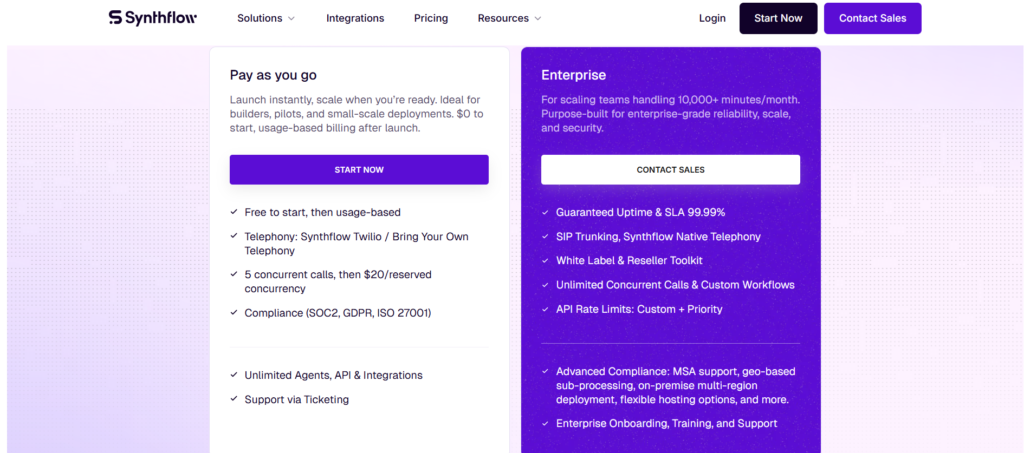
Synthflow currently has two main pricing models: Pay As You Go and Enterprise. The Pay As You Go starts at $0 per month and then bills usage based on LLM and voice engine costs, which the company estimates at roughly $0.15 to $0.24 per minute. The Pay As You Go plan includes standard support and five units of concurrency, which can be expanded. Enterprise pricing is custom and adds features such as unlimited concurrency, a 99.99% uptime SLA, and dedicated support.
For buyers, the practical takeaway is simple. Synthflow does not price itself like a casual consumer tool. It is meant for real deployment. A team should evaluate cost in relation to minutes used, concurrency needs, and downstream workflow value, not just entry-level sticker price.
Pros and Limitations of Synthflow AI
A useful Synthflow AI review should not read like a sales deck, so it is worth being direct here.
Pros
The strongest advantage is that the platform is built around real business workflows rather than only around novelty. The combination of no-code agent building, telephony integration, CRM and automation support, and appointment-booking flows gives it practical depth.
Another strength is deployment flexibility. Businesses can test quickly with a number, scale via Twilio, or move into SIP/PBX integrations if they need deeper control. That is a more serious operational story than many AI startups can offer.
The company also appears well-capitalized and commercially validated, at least relative to many younger tools in the category. The 2025 Series A and reported 1,000-plus enterprise clients suggest that real buyers are using it.
Limitations
The first limitation is complexity. The platform is no-code, but that does not mean it is frictionless. Voice automation still requires careful thinking about call flows, escalation paths, integrations, and failure handling. Businesses expecting “set it up in ten minutes and forget about it” may underestimate the work involved.
The second limitation is economics for smaller teams. Usage-based pricing can make perfect sense for companies with strong phone workflows, but it may feel heavy for businesses that only need occasional automation or are still exploring whether voice AI matters to them.
The third limitation is category-level rather than company-specific. Voice AI still depends on trust. Even with strong infrastructure, some businesses may hesitate to let AI handle sensitive customer conversations without close oversight. That is not necessarily a flaw in Synthflow alone, but it is part of the reality of the space.
Synthflow AI Alternatives
No platform exists in a vacuum, and voice AI is becoming crowded.
One cluster of alternatives includes more infrastructure-oriented platforms such as Vapi and Retell AI, which often appeal to technical teams or teams comfortable building more custom voice systems.
Another cluster includes more polished voice-generation or conversational players such as ElevenLabs Agents or Bland AI, depending on the exact use case and stack preference.
The right comparison depends on what the buyer values most. If the priority is no-code deployment and business workflow integration, Synthflow has a clear story. If the priority is developer flexibility, another platform may be more attractive. If the business wants a lighter experimentation layer rather than a more operational system, the tradeoff changes again.
The key point is that Synthflow is not competing only on “AI voice.” It is competing on how usable voice AI becomes inside an actual business process.
How Businesses Use Synthflow in Real Workflows
This is where the product becomes easier to evaluate.
A service business can use Synthflow to answer inbound calls after hours, collect basic details, offer available slots, and book appointments directly into a calendar. That is not speculative; the booking documentation is clearly built for this.
A lead-generation team can connect form submissions or CRM updates through Zapier or Make and trigger outbound AI calls as part of a follow-up workflow. If the lead answers, the agent can qualify, gather details, and push outcomes back into the stack.
A company with a heavier phone operation can use SIP/PBX integration to place Synthflow alongside its existing telephony setup instead of ripping out infrastructure. That lowers the barrier for enterprises that want augmentation rather than total replacement.
This is why the platform matters more than a typical “AI can talk on the phone” demo. Its value is not the call itself. Its value is what the business can automate around the call.
Is Synthflow AI Worth Using?
For the right business, yes.
If a company has meaningful phone volume, repetitive call workflows, and a clear reason to automate qualification, booking, or basic support, Synthflow is a serious platform worth evaluating. Its strongest case is not entertainment or novelty. It is operational efficiency.
For businesses that barely use the phone as a channel, the tool is much less compelling. In those environments, voice automation may simply not be the bottleneck worth solving.
So the answer depends less on whether voice AI is impressive and more on whether phone interactions are central enough to justify workflow automation. If they are, Synthflow looks like one of the more credible no-code options in the space.
Frequently Asked Questions (FAQs)
What does Synthflow AI do?
Synthflow AI helps businesses build AI voice agents that can automate phone conversations across inbound and outbound workflows. The platform supports use cases such as answering questions, booking appointments, qualifying leads, and routing calls.
Is Synthflow AI no-code?
Yes. The company positions Synthflow as a no-code platform, which means businesses can build and deploy voice agents without needing to code the full system from scratch.
Can Synthflow AI book appointments?
Yes. Synthflow documents a real-time booking workflow that allows agents to check calendar availability, propose slots, confirm bookings, and send confirmations during the call.
Does Synthflow AI work with existing phone systems?
Yes, depending on the setup. The platform supports test numbers, Twilio-based deployment, and SIP/PBX integration for enterprise customers who want to connect existing phone infrastructure.
How much does Synthflow AI cost?
According to the current billing documentation, Synthflow offers a Pay As You Go model starting at $0 per month with usage-based voice and LLM costs, plus custom Enterprise pricing for larger deployments.
Who should use Synthflow AI?
Synthflow is best suited for businesses that rely on phone workflows and want to automate repetitive conversations. That includes service businesses, appointment-based organizations, sales teams, agencies, and enterprises with meaningful call volume.