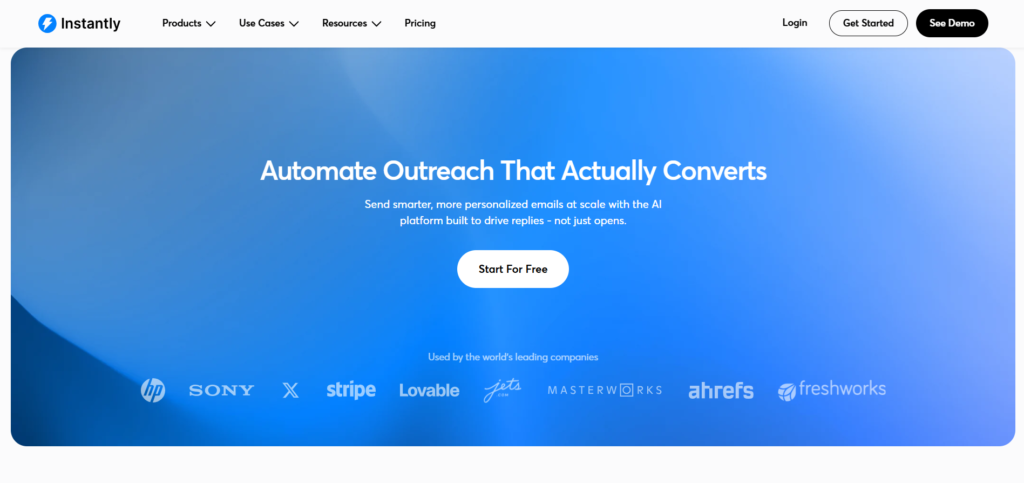
If you’ve ever tried cold email at scale, you already know the real problem is not writing emails. It’s getting them delivered. Instantly AI positions itself exactly at that pressure point. Not as another email marketing tool, but as infrastructure for outbound teams who need to send volume without burning domains.
This Instantly AI review breaks it down the way an operator would evaluate it. What it actually does, where it works, where it doesn’t, and whether it’s worth paying for.
Table of Contents
What Instantly AI Is Actually Built For
Most people land on Instantly expecting a standard email marketing platform. That assumption creates confusion early. The product makes a lot more sense once you reframe it as a comprehensive sales engine.
Not an Email Marketing Tool
Instantly is not built for newsletters, ecommerce, or customer retention. If you are nurturing a list of 5,000 existing customers, you are looking at the wrong category. This is outbound-first infrastructure.
The 2026 Core Promise
The platform now solves three specific problems in a single workflow:
- Lead Intelligence: Finding the right people (SuperSearch 450M+ database).
- Deliverability at Scale: Keeping those emails out of the spam folder (Warm-up & SISR).
- Conversation Automation: Managing and even replying to leads using AI agents.
Everything in the product flows from this. If you judge it on copywriting or design features, you will miss the point entirely.
Where Instantly AI Stands Out
Most tools in this space claim automation. Very few solve deliverability at the system level. That is where Instantly differentiates itself.
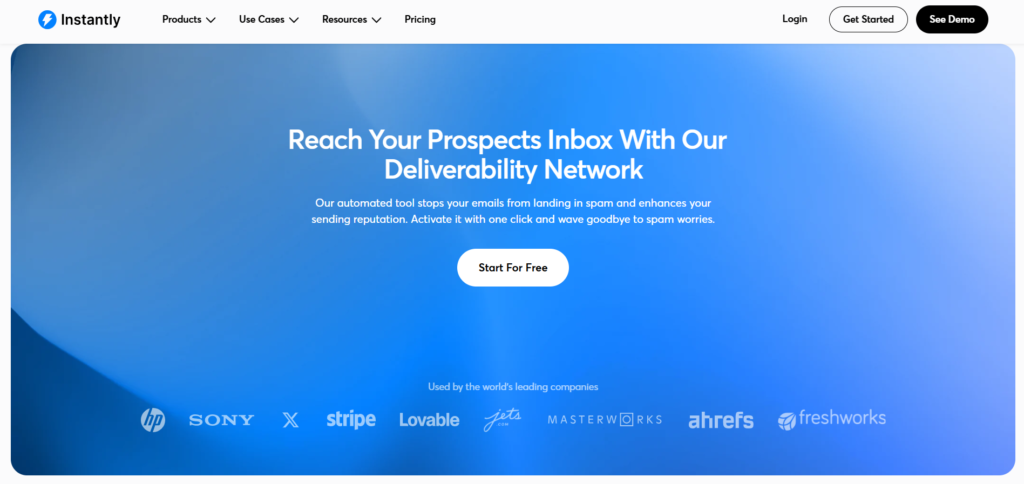
Deliverability Infrastructure
This is the core of the product. Instantly doesn’t just “send” emails; it protects the technical health of your domains.
- Warm-up Network: Access to a private pool of over 4 million real email accounts that interact with your inbox to build a human-like reputation.
- SISR (Server & IP Sharding): For high-volume users (Light Speed tier), Instantly now includes SISR. This automatically rotates your campaigns across dedicated server blocks and IP pools, ensuring that if one IP is flagged, your entire operation doesn’t collapse.+1
- Automated Guardrails: The system now auto-pauses any mailbox if the bounce rate exceeds 2% or if spam placement spikes, effectively replacing a full-time deliverability consultant.
Multi-Inbox Scaling
A single inbox has limits. Send more than 30–50 emails a day, and you risk a permanent ban. Instantly’s “Unlimited Accounts” model allows you to:
- Horizontal Scaling: Instead of sending 500 emails from one account, you send 25 emails from 20 different accounts.
- Inbox Rotation: The system automatically cycles through your connected inboxes so no single domain carries too much “heat.” This is the “secret sauce” that allows small teams to behave like massive sales organizations.
Campaign Automation (2026 Update)
In earlier versions, Instantly’s sequencing was basic. Today, it has evolved into a sophisticated engine:
- Behavioral Subsequences: You can now branch campaigns. For example, if a lead clicks a link but doesn’t reply, they are automatically moved to a specific “High Intent” follow-up sequence.
- AI-Powered Personalization: Using their AI Sales Agent, the tool can now scan a prospect’s website and write a custom opening line for every individual email in your list.
- Advanced A/Z Testing: You aren’t limited to just two versions of an email. You can test up to 26 variations (A through Z) of subject lines and bodies simultaneously to find the winner faster.
What Instantly AI Does Not Do Well
This is where most reviews become vague. The tradeoffs matter, especially if you are deciding between tools.
Not Built for Traditional Email Marketing
Instantly is weak in areas that matter for marketing teams:
- No advanced segmentation
- No customer lifecycle tracking
- No campaign analytics depth like marketing platforms
If your use case involves nurturing existing users, this tool will feel limited.
Limited AI Depth
Despite the name, AI is not the core engine here.
You will find:
- Some assistance in writing
- Basic suggestions
But this is not a content-first tool.
The real value sits in infrastructure, not intelligence. Teams that expect AI to generate high-converting emails out of the box often end up disappointed.
Learning Curve for Beginners
There is operational overhead involved:
- Setting up domains
- Connecting multiple inboxes
- Understanding sending limits
- Managing lists and sequences
For someone new to outbound, this can feel heavy.
For someone who has already tried scaling cold email manually, this feels like a relief.
Pricing: Is It Worth It?
Pricing is where the product often gets misunderstood. It looks like a SaaS subscription. It behaves more like infrastructure cost.
Pricing Overview
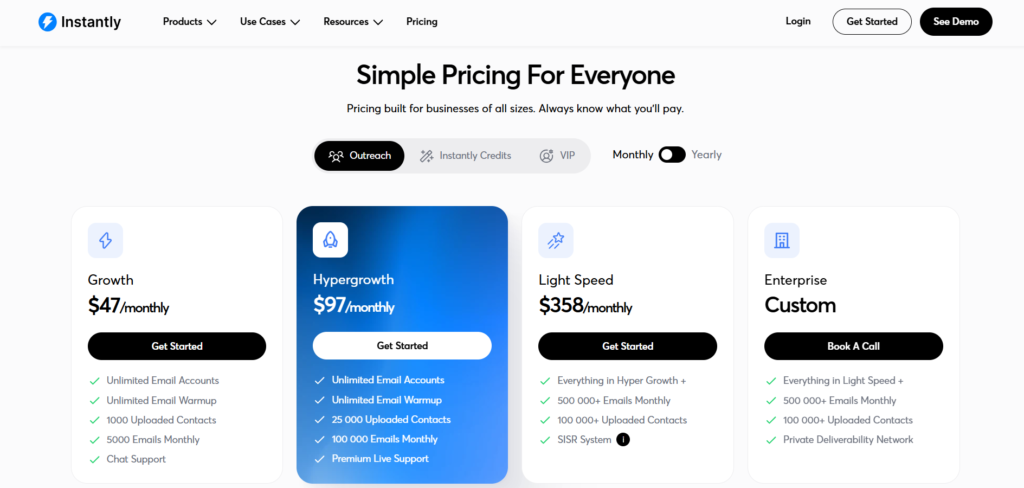
Instantly pricing plans typically start around $37–$47/month (Growth) for testing, but most operators land on the $97/month (Hypergrowth) plan to access the “Unibox” and A/Z testing.
Plans scale up as you add more inboxes and campaigns.
What You’re Actually Paying For
You must budget for the “Hidden Stack”:
- Outreach Subscription: The base fee ($47–$97+).
- Lead Credits: SuperSearch is often a separate add-on ($47/mo+).
- Mailbox Costs: You still have to pay Google or Microsoft for the actual email accounts (e.g., 20 mailboxes at $6/each = $120/mo).
Verdict: If your revenue per lead is high, the “all-in-one” convenience and deliverability protection make it one of the most cost-effective ways to scale outbound in 2026.
Who Should Pay for It
The economics work if:
- Each converted lead has meaningful value
- You are running outbound at scale
- You care about inbox placement
Typical strong users include:
- Agencies running outreach for clients
- B2B founders doing outbound sales
- Lead generation teams
If your revenue per lead is low, the math may not justify the cost.
Who Instantly AI Is Best For
The product is not general-purpose. Fit matters a lot.
Strong Fit
Instantly works well for:
- Cold outreach teams
- B2B SaaS companies
- Agencies managing multiple clients
- Founders validating markets through outbound
These users benefit directly from improved deliverability and scaling.
Poor Fit
It is a poor fit for:
- Ecommerce brands
- Newsletter creators
- Content-driven email marketing
- Lifecycle marketing teams
For these use cases, tools in your AI email marketing tools stack will perform far better.
Instantly AI vs Email Marketing Tools
This is where confusion usually happens, especially for people entering the space.
Instantly vs Klaviyo
Klaviyo is built for:
- Customer data
- Segmentation
- Revenue tracking
Instantly is built for:
- Cold outreach
- Inbox placement
- Scaling new conversations
One drives retention. The other drives acquisition.
Instantly vs Mailchimp
Mailchimp focuses on:
- Campaigns
- Lists
- Engagement metrics
Instantly focuses on:
- Sending infrastructure
- Deliverability
- Multi-inbox systems
They solve completely different problems, even though both involve email.
If your goal is marketing, use marketing tools. If your goal is outbound, Instantly starts to make sense.
Instantly AI Alternatives
No tool exists in isolation. The alternatives help clarify positioning.
Smartlead AI: The primary rival. Choose Smartlead if you are an agency needing a deep API and “Master Inbox” control. Choose Instantly if you want the integrated lead database (SuperSearch) and a more intuitive UI.
Lemlist: Still the leader for creative, multi-channel outreach (LinkedIn + Email). If you prioritize “quality over quantity” with custom images and videos, Lemlist wins.
Apollo: Apollo is a “Data first, Sending second” tool. Instantly is a “Deliverability first, Data second” tool. Use Instantly if your primary concern is landing in the primary inbox rather than the “Promotions” tab.
Each alternative represents a different tradeoff between control, simplicity, and scope.
Final Verdict
Instantly AI is not a better email tool. It is a different category altogether.
If your goal is to send emails, there are dozens of tools that can do that.
If your goal is to send emails that actually land in the inbox at scale, the problem becomes operational. That is where Instantly starts to matter.
The decision is not about features. It is about use case clarity.
Outbound teams that understand deliverability will see the value immediately. Everyone else will wonder why the product feels limited.
That gap in perception is exactly what defines this tool.