Content creation has always been one of the central activities in marketing. Every campaign, product launch, and brand initiative eventually depends on words that communicate value clearly and persuade audiences to take action. For decades, this work followed a familiar rhythm. A marketing team would research the audience, outline ideas, draft content, revise it through multiple rounds of editing, and finally publish the result.
Artificial intelligence has begun to reshape that process. AI copywriting tools can now generate blog drafts, marketing copy, landing page messaging, and campaign variations in seconds. What once required hours or days of writing can begin with a prompt and produce a structured draft almost immediately.
This shift has created a practical question for marketing teams. Should content still be produced using traditional workflows, or do AI copywriting tools offer a better approach? The answer is more nuanced than either side of the debate usually suggests. Each approach has strengths, limitations, and ideal use cases. Understanding how they differ helps marketers choose the right method for different types of content.
Key Takeaways
- AI copywriting tools dramatically accelerate the content drafting process. Marketing teams can generate structured drafts, headlines, and campaign messaging in seconds instead of starting from a blank page.
- Traditional content creation still plays a critical role in strategy and storytelling. Human writers bring context, originality, and brand voice that automated systems cannot fully replicate.
- AI tools are especially useful for high-volume marketing tasks. Blog drafts, landing page copy, product descriptions, and campaign variations can be produced far more efficiently with AI assistance.
- The most effective approach today is a hybrid workflow. Many marketing teams use AI to create the initial draft and then rely on human editors to refine the message, improve clarity, and ensure brand consistency.
- AI enables faster experimentation and campaign testing. Teams can quickly generate multiple variations of headlines, calls to action, and promotional messages to discover what resonates most with their audience.
Table of Contents
AI Copywriting Tools vs Traditional Content Creation: How Traditional Content Creation Works
Traditional content creation relies entirely on human writers and editors. While the process can vary slightly depending on the organization, most teams follow a similar sequence of steps that move content from idea to publication.
The Traditional Content Production Workflow
A typical traditional content workflow begins with research. Writers gather information about the audience, the topic, and the broader context of the content. This stage might involve reading industry reports, studying competitors, interviewing subject matter experts, or analyzing campaign goals.
Once research is complete, the writer creates an outline that structures the content logically. The outline ensures the article or campaign message follows a clear narrative and covers the necessary points.
The next stage is drafting. The writer expands the outline into full paragraphs, building the argument, explaining concepts, and shaping the tone of the message. This stage often takes the most time because it requires careful thinking, creativity, and clarity.
After the draft is completed, the editing process begins. Editors review the content for accuracy, tone, clarity, and consistency with brand guidelines. In many organizations, several rounds of revisions occur before the content is approved for publication.
This workflow is deliberate and often produces high-quality material. It also requires time and coordination between multiple contributors.
Strengths of Traditional Content Creation
Traditional content creation offers several advantages that remain important in marketing today.
Human writers bring context and judgment to the writing process. They can interpret complex ideas, craft nuanced arguments, and adjust tone depending on the audience. This flexibility allows them to produce content that feels thoughtful and authentic.
Human copywriters also excel at storytelling. Brand narratives, founder stories, and thought leadership articles often depend on emotional nuance and cultural awareness that machines struggle to replicate convincingly.
Another advantage lies in editorial control. Human-driven processes allow teams to carefully refine messaging until it matches the brand’s voice and strategic positioning.
For these reasons, traditional workflows continue to play a central role in many forms of marketing communication.
AI Copywriting Tools vs Traditional Content Creation: What AI Copywriting Tools Do
AI copywriting tools use large language models to generate text based on prompts provided by users. Instead of composing content line by line, marketers describe the topic, audience, and goals, and the system produces a structured draft.
These tools rely on patterns learned from large datasets of language. By analyzing how words and ideas typically appear together, they generate sentences that resemble human writing.
How AI Writing Tools Generate Content
The process usually begins with a prompt. A marketer might describe the product, the audience, and the objective of the content. The AI interprets that input and predicts the next sequence of words that forms a coherent response.
Within seconds, the system can produce a draft that includes headlines, paragraphs, or lists of ideas. The output is not the result of original research in the traditional sense. Instead, it reflects patterns learned from existing text across many domains.
This ability allows AI tools to create structured content quickly, often covering common frameworks used in marketing.
Types of Content AI Tools Can Produce
AI copywriting tools are particularly effective at generating content types that follow recognizable patterns. Examples include blog drafts, marketing copy, product descriptions, and landing page messaging.
Many tools can also generate variations of headlines, calls to action, and promotional text. This capability allows marketers to test multiple versions of campaign messaging without writing each version manually.
Because the system produces drafts so quickly, teams often use AI as a starting point rather than a finished product.
AI Copywriting vs Traditional Content Creation: Key Differences
Comparing AI copywriting tools with traditional content creation reveals several important differences. These differences affect how quickly content can be produced, how much it costs, and how easily teams can scale their output.
Speed of Content Production
Traditional content creation can take significant time. Research, drafting, editing, and approvals may span several days or weeks depending on the complexity of the material.
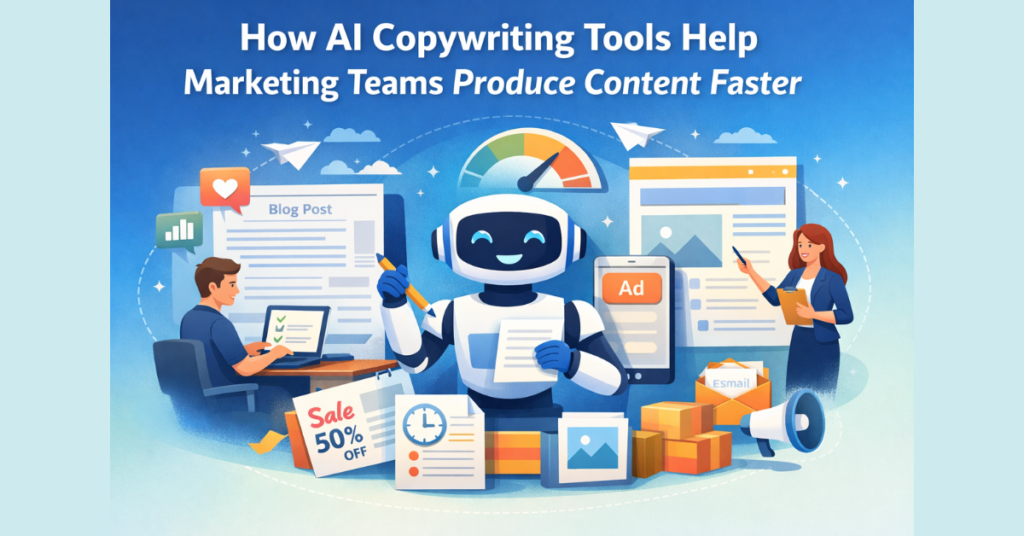
AI tools dramatically accelerate the early stages of this process. A structured draft can appear in seconds, allowing writers to move directly into refinement and editing. This speed makes AI especially valuable when marketing teams need to produce large volumes of content quickly.
Cost of Content Creation
Producing content through traditional methods often requires significant resources. Companies may employ in-house writers, hire freelance copywriters, or work with agencies.
AI tools reduce some of these costs by generating drafts automatically. While human editing remains necessary, the initial drafting stage becomes much faster and less expensive.
For organizations producing high volumes of marketing content, this efficiency can significantly reduce production costs.
Scalability for Marketing Teams
Traditional workflows scale slowly because each piece of content requires time from human writers. When demand increases, teams must hire additional writers or extend production timelines.
AI tools scale more easily. A single system can generate dozens of content drafts in the time it might take a writer to complete one article. This scalability allows marketing teams to support more campaigns without dramatically expanding their staff.
Creativity and Originality
Human writers still hold an advantage when it comes to originality and creative insight. They can connect ideas across disciplines, introduce unexpected perspectives, and craft distinctive narratives.
AI systems generate text based on patterns from existing language. While the output may be coherent and useful, it can sometimes feel predictable or generic if not carefully guided.
Creative campaigns, brand storytelling, and thought leadership content still benefit heavily from human creativity.
Editing and Quality Control
Traditional content workflows include careful editorial review at every stage. Writers and editors refine the message until it meets the organization’s standards.
AI-generated content also requires editing, but the process is slightly different. Instead of shaping a draft from scratch, editors evaluate the AI output and adjust it for accuracy, clarity, and tone.
The editing stage therefore remains essential regardless of how the initial draft was produced.
When Traditional Content Creation Works Best
Although AI tools can assist with many tasks, certain types of content still benefit strongly from traditional writing methods.
Brand Storytelling
Brand storytelling often requires emotional nuance and cultural sensitivity. Writers must understand the audience’s motivations and shape a narrative that resonates on a deeper level.
This type of work typically involves more than assembling facts. It requires interpretation and empathy, qualities that human writers bring naturally.
Thought Leadership Articles
Thought leadership content depends on original insight. Executives and subject matter experts use these articles to share ideas, analyze trends, and express distinctive viewpoints.
AI tools can assist with drafting or structuring such content, but the underlying ideas must come from human expertise.
Complex Research Content
Articles that involve extensive research, technical explanation, or investigative reporting usually demand careful analysis. Writers must verify sources, interpret data, and construct logical arguments.
Human oversight ensures accuracy and credibility in these situations.
When AI Copywriting Tools Work Best
AI tools shine in areas where speed, repetition, and experimentation matter most.
Marketing Copy
Marketing copy often follows recognizable structures. Headlines, value propositions, and promotional descriptions can be generated quickly by AI systems.
Marketers can then refine these drafts to align with campaign goals.
SEO Blog Drafts
Search-focused blog articles frequently follow predictable patterns. AI tools can generate outlines and draft sections that writers later refine.
This approach reduces the time spent on early drafting while preserving editorial quality.
Campaign Messaging
Campaigns often require multiple versions of messaging for different channels. AI tools help generate variations for ads, landing pages, and email sequences.
This capability allows teams to test messaging ideas rapidly.
Product Descriptions
Ecommerce platforms often require hundreds or thousands of product descriptions. AI systems can generate these descriptions efficiently while maintaining consistent formatting.
How Marketing Teams Combine AI and Traditional Copywriting
Most organizations do not choose between AI and traditional writing. Instead, they combine both approaches into a hybrid workflow that captures the advantages of each.
AI for First Drafts
Many teams now use AI tools to produce the first draft of content. This eliminates the blank page problem and accelerates the writing process.
The AI provides structure and initial wording that writers can refine.
Human Editing for Persuasion
Human editors review the draft to improve clarity, tone, and persuasive impact. They ensure the message reflects the brand’s voice and strategic positioning.
This stage transforms the raw AI output into polished marketing content.
AI for Testing Variations
After the content is published, AI tools help generate new variations for testing. Marketers experiment with different headlines, calls to action, or messaging angles to improve performance.
This iterative process allows teams to optimize campaigns continuously.
Advantages of AI Content Creation for Marketing Teams
AI content creation offers several practical benefits for marketing organizations.
Faster Campaign Execution
Campaign timelines often depend on how quickly content can be produced. AI tools allow teams to generate drafts immediately, shortening the time required to launch new initiatives.
Higher Content Output
Because AI can generate multiple drafts quickly, teams can produce more content without increasing staffing levels.
Easier Content Testing
Marketing success often depends on testing multiple messaging variations. AI tools make it easier to create these variations and experiment with different approaches.
Limitations of AI Copywriting Tools
Despite their advantages, AI tools also have limitations that marketers must understand.
Generic Content Risk
If prompts are vague or incomplete, AI-generated text may appear generic. Marketers must provide detailed guidance to produce meaningful results.
Lack of Deep Expertise
AI systems do not possess true understanding or domain expertise. They rely on patterns from existing language rather than independent reasoning.
Dependence on Prompts
The quality of AI output depends heavily on the quality of the prompts provided by the user. Poor instructions lead to weaker results.
The Future of Content Creation in Marketing
Content creation is entering a hybrid era. AI tools will likely continue improving, offering faster drafting and more sophisticated content generation. At the same time, human creativity and strategic thinking will remain essential.
Marketing teams that combine both approaches effectively gain a significant advantage. AI accelerates production and experimentation, while human writers refine the message and guide the narrative.
Rather than replacing traditional content creation, AI is transforming how it begins. The blank page is disappearing, replaced by a collaborative process in which machines generate drafts and humans shape them into meaningful communication.
Frequently Asked Questions (FAQ)
What is the difference between AI copywriting and traditional content creation?
AI copywriting tools generate text automatically based on prompts provided by the user. Traditional content creation relies entirely on human writers who research, draft, and edit content manually. AI tools focus on speed and scalability, while traditional writing emphasizes creativity, context, and editorial judgment.
Can AI completely replace human copywriters?
AI tools are unlikely to replace human copywriters entirely. While they can generate drafts quickly, human writers remain essential for shaping brand voice, developing original ideas, and ensuring content accuracy. Most organizations use AI as a productivity tool rather than a full replacement for human creativity.
When should marketing teams use AI copywriting tools?
AI copywriting tools work best for tasks that require speed and volume. Examples include SEO blog drafts, product descriptions, social media captions, landing page messaging, and campaign variations. These tools help marketing teams produce large amounts of content efficiently.
When is traditional content creation the better choice?
Traditional content creation is usually better for thought leadership articles, brand storytelling, research-based content, and highly strategic messaging. These types of content benefit from deeper insight and a distinctive voice that human writers provide.
Do AI-generated articles require editing?
Yes, AI-generated content should always be reviewed and edited by humans. Editing helps ensure the information is accurate, the tone matches the brand, and the message communicates clearly to the intended audience.
Why are marketing teams adopting AI writing tools so quickly?
Marketing teams face constant pressure to produce more content across blogs, social media, email campaigns, and advertising channels. AI writing tools reduce the time needed to generate drafts and help teams experiment with multiple messaging variations, making them valuable productivity tools.