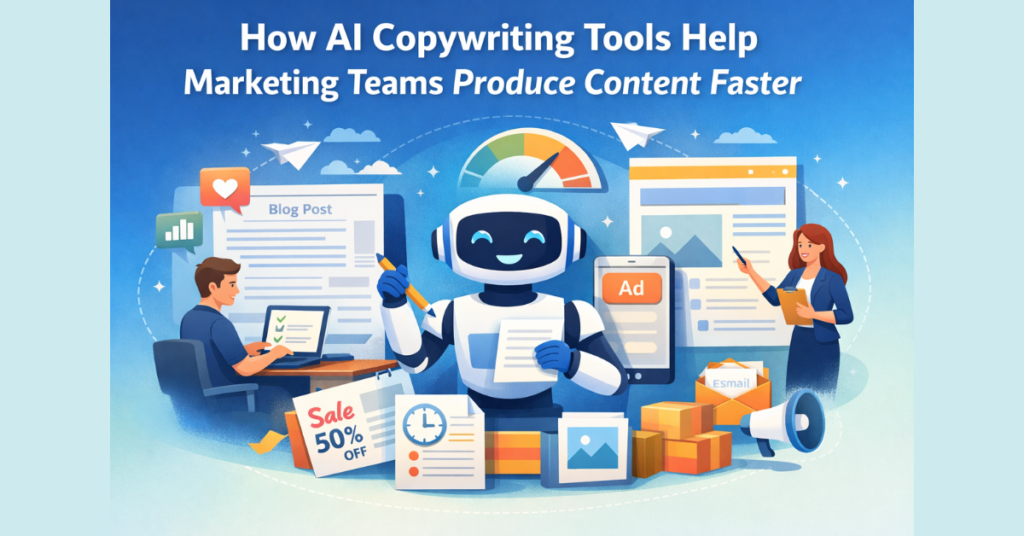
Marketing teams today produce more written content than ever before. Blog articles, landing pages, social media posts, ad copy, product descriptions, and email campaigns all depend on clear and persuasive writing. The challenge is that this work never really slows down. Campaigns change, new products launch, and search engines continue to reward fresh content. For many teams, keeping up with this demand has become one of the hardest parts of modern marketing.
This is where AI copywriting tools have started to change the way marketers work. Instead of staring at a blank page, marketers can now generate drafts, explore variations of headlines, or develop campaign ideas within seconds. Used well, these tools do not replace human creativity. They help accelerate the early stages of writing so teams can focus on refining the message and shaping it for their audience.
In this guide, we look at some of the most widely used AI copywriting tools from a practical marketing perspective. Rather than focusing only on features, we will explore how marketers actually use these platforms in everyday workflows. By the end, you should have a clearer sense of which tools fit different marketing situations and how they can help you produce content more efficiently.
Table of Contents
What AI Copywriting Tools Are
AI copywriting tools are software platforms that use large language models to generate written content from simple prompts. Instead of writing every sentence from scratch, a marketer can describe the type of content they need, provide a few instructions, and the tool produces a draft within seconds.
Most of these tools are built on similar underlying AI technologies, but they differ in how they structure workflows for marketing teams. Some focus on long-form content such as blog posts and landing pages. Others specialize in short marketing assets like ads, product descriptions, and social media captions.
To understand how these tools fit into marketing workflows, it helps to look at the kinds of tasks they typically assist with.
Generating first drafts
One of the most common uses of AI copywriting tools is generating the first version of a piece of content. A marketer might enter a prompt describing the topic, audience, and tone of voice. The tool then produces a draft that can be refined and edited.
This approach reduces the time spent starting from a blank page. The marketer still shapes the final message, but the early stages of writing become much faster.
Producing multiple variations of marketing copy
Marketing often involves testing different versions of headlines, ad copy, or email subject lines. AI tools can generate several variations of the same message in seconds.
Instead of manually rewriting a headline ten different ways, a marketer can ask the tool to produce multiple options and then choose the ones worth testing in a campaign.
Assisting with long-form content
Some AI writing platforms are designed to help produce longer pieces of content such as blog articles, guides, or landing pages. These tools can generate outlines, expand sections, and help structure longer documents.
Used carefully, they help speed up content production while still allowing the writer to guide the narrative and ensure the content aligns with the brand voice.
Supporting everyday marketing workflows
Beyond individual pieces of content, AI copywriting tools often become part of the daily workflow of marketing teams. They are used for brainstorming campaign ideas, refining messaging, and quickly drafting material for different channels.
When used thoughtfully, these tools act less like automatic content generators and more like collaborative assistants that help marketers move from idea to draft much faster.
How Marketers Use AI Copywriting Tools
Understanding what these tools are is helpful, but the real value appears when you see how marketing teams actually use them in day-to-day work. In practice, AI copywriting tools rarely replace the marketer. Instead, they shorten the time it takes to move from an idea to a workable draft.
Different teams integrate these tools into their workflows in slightly different ways, but a few common patterns appear across agencies, startups, and in-house marketing teams.
Blog content and SEO articles
One of the most common uses is producing first drafts of blog articles and SEO content. Marketing teams often begin with a topic, a few bullet points, and a desired tone. The AI tool generates an outline and a draft that the writer can refine and expand.
This approach reduces the time spent building the initial structure of an article. The marketer still edits the text, adds examples, and ensures the content aligns with the brand voice, but the early stages of writing move much faster.
For companies publishing regular blog content, this workflow can significantly increase output without expanding the writing team.
Advertising and campaign copy
Ad campaigns require many variations of short marketing messages. Headlines, taglines, and ad descriptions often need to be tested across different platforms.
AI copywriting tools are particularly useful here because they can generate multiple versions of the same idea quickly. Marketers can review a range of options and select the strongest ones for testing.
This process speeds up campaign development and makes it easier to experiment with different messaging angles.
Landing pages and product messaging
Another common workflow involves creating landing pages for products or campaigns. Writing a clear headline, value proposition, and supporting text often requires several iterations.
Marketers use AI tools to explore different ways of presenting the same message. The tool may suggest alternate headlines, descriptions, or benefit statements, which can then be refined by the marketing team.
The result is often a faster path to a polished landing page.
Email campaigns
Email marketing also benefits from AI-assisted writing. Marketers frequently use these tools to generate subject line ideas, draft email sequences, and experiment with different tones of communication.
Because email campaigns rely heavily on engagement and open rates, having multiple variations to test can be extremely useful. AI tools make it easier to produce these variations quickly.
Idea generation and creative exploration
Beyond producing finished drafts, many marketers use AI copywriting tools simply to explore ideas. When starting a new campaign or content project, the tool can generate angles, messaging themes, or topic suggestions.
This kind of brainstorming support often helps teams move past the early stage where ideas feel vague or unfinished.
When used this way, AI copywriting tools act less like automatic writers and more like collaborative assistants that help marketers explore possibilities before refining the final message.
Best AI Copywriting Tools for Marketing
The AI copywriting market has expanded quickly over the past few years. What started as simple text generators has evolved into a broad set of tools that support different parts of the marketing workflow. Some platforms focus on long-form content and SEO writing, while others specialize in campaign messaging, product marketing, or advertising copy.
The tools below represent a mix of established platforms and newer entrants that marketing teams are actively experimenting with today. Each one approaches AI-assisted writing slightly differently, which is why understanding their strengths helps when choosing the right platform.
Jasper
Jasper has long positioned itself as an AI writing platform built specifically for marketing teams rather than general text generation. Over time it has evolved into a broader marketing content platform that supports campaign creation, blog content, landing pages, and brand messaging.
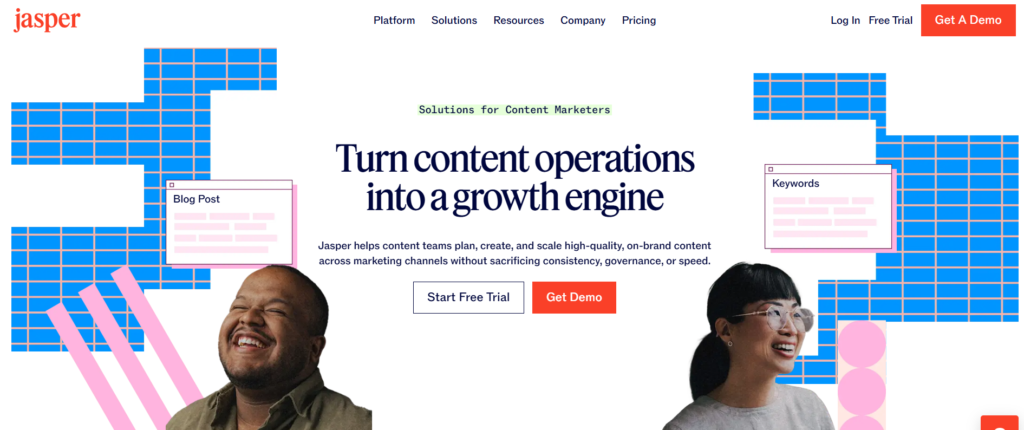
One of Jasper’s most important capabilities is brand voice management. Teams can train the platform on brand guidelines, tone, and style so that generated content aligns with existing messaging. This becomes particularly useful for organizations producing content across multiple channels and writers.
Jasper also provides structured templates designed around marketing use cases such as product descriptions, ad headlines, email campaigns, and landing page sections. Many agencies use the platform to accelerate content production while maintaining consistency across campaigns.
Because of its collaboration features and brand controls, Jasper is often adopted by larger marketing teams rather than individual creators.
Best suited for:
Marketing teams and agencies that need consistent brand messaging across multiple campaigns and content formats.
Copy.ai
Copy.ai began as a lightweight AI writing tool for generating marketing copy such as product descriptions and ad headlines. Over time the platform has expanded into a broader workflow-based content generation system.
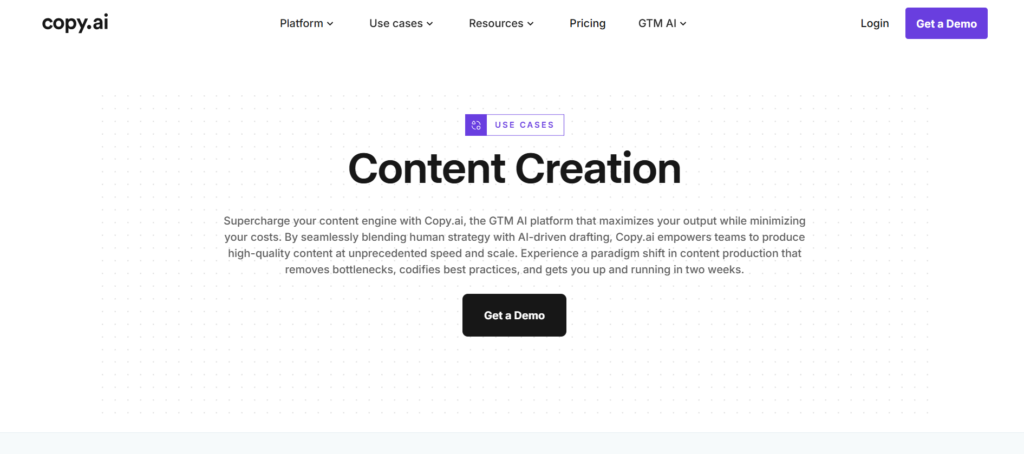
Instead of focusing only on writing prompts, Copy.ai now organizes tasks into structured workflows. These workflows guide users through common marketing activities such as building product messaging, creating email sequences, or generating campaign content.
This structure makes the platform approachable for marketers who want assistance generating ideas and drafts without building complex prompt instructions. Many startups and smaller teams rely on Copy.ai because it simplifies the process of producing marketing content quickly.
Another aspect that appeals to growth teams is the platform’s ability to generate multiple content variations for experimentation, which is particularly useful for campaign testing.
Best suited for:
Startups and smaller marketing teams that want a straightforward system for producing marketing copy and campaign content.
Writesonic
Writesonic has become widely used among content marketers because of its focus on long-form content and SEO workflows. The platform includes tools designed to help marketers move from topic ideas to structured blog articles.

One of its key strengths is the integration of content generation with SEO research features. Marketers can generate outlines, expand article sections, and optimize content around target keywords within the same environment.
Writesonic also provides tools for writing landing pages, advertising copy, and product descriptions, but its strongest adoption tends to be among teams producing regular blog content as part of their SEO strategy.
Many marketing teams use Writesonic as part of a broader content production pipeline where AI assists with outlining and drafting while human writers refine the final article.
Best suited for:
Content marketing teams producing blog articles and SEO-driven content on a regular basis.
Rytr
Rytr occupies a different position in the market compared with many of the larger AI writing platforms. It focuses on simplicity and affordability rather than extensive workflow automation.
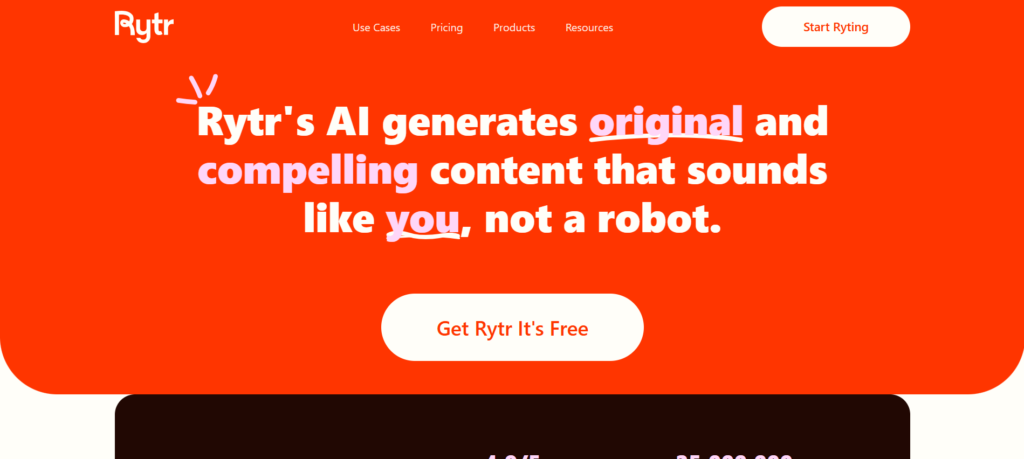
The interface is intentionally minimal. Users choose a content type, provide a prompt, and the system generates a draft quickly. This simplicity makes the platform easy to learn, especially for users who are experimenting with AI writing tools for the first time.
Because of its lightweight design, Rytr is commonly used by freelancers, consultants, and small business owners who want quick assistance writing short marketing content. Typical use cases include social media captions, product descriptions, ad copy, and short blog drafts.
While it does not provide the advanced collaboration features found in larger platforms, its accessibility makes it a practical entry point for many users.
Best suited for:
Freelancers and small businesses looking for an affordable and easy-to-use AI writing assistant.
Anyword
Anyword approaches AI copywriting from a performance marketing perspective. Rather than focusing primarily on long-form writing, the platform concentrates on optimizing marketing messages for engagement and conversions.
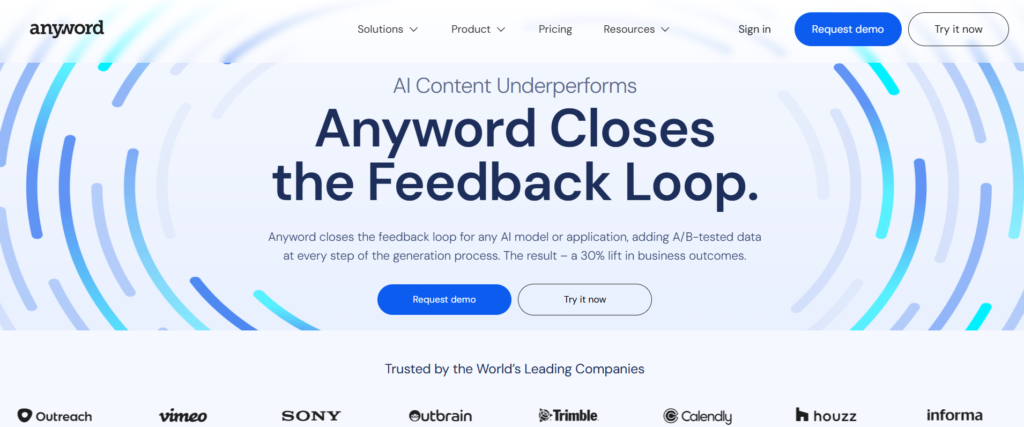
One of its distinguishing features is predictive performance scoring. The system analyzes generated copy and estimates how well it might perform across advertising channels before it is used in a campaign. This can help marketers experiment with different headlines or messaging angles more quickly.
The platform is particularly useful for teams running paid advertising campaigns where testing multiple variations of ad copy is essential. By generating several alternatives and evaluating them before launch, marketers can narrow down stronger options for experimentation.
Because of this emphasis on advertising performance, Anyword is frequently used by growth marketing teams managing campaigns across search and social platforms.
Best suited for:
Marketing teams focused on performance marketing, advertising campaigns, and message testing.
Content Hub (from Semrush)
Content Hub (previously known as ContentShake AI), developed by Semrush, represents a newer generation of AI writing tools that integrate SEO research directly into the content creation process.
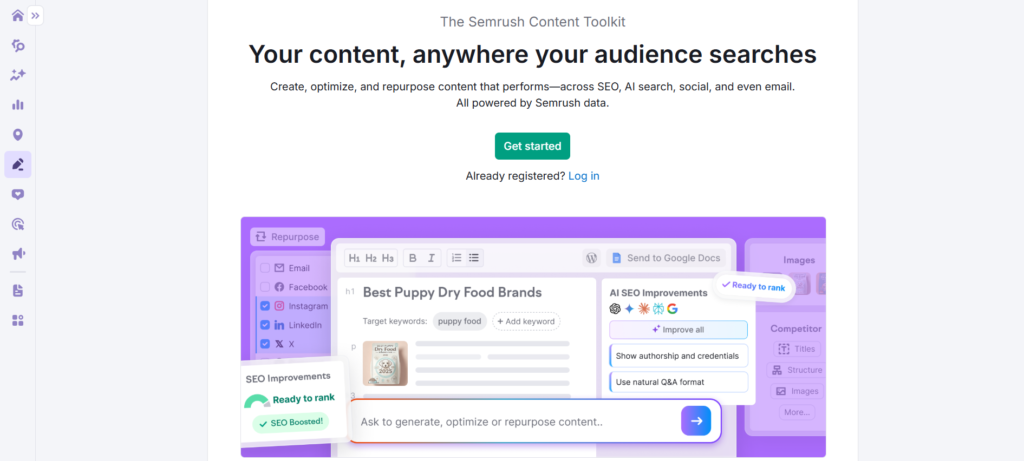
Instead of starting with a blank prompt, marketers can begin with keyword research and topic ideas generated from search data. The platform then helps build an article outline and draft content aligned with search intent.
For teams already using SEO tools as part of their content strategy, this integration can simplify the process of moving from keyword research to article creation. It allows marketers to develop blog content that aligns more closely with what users are searching for.
ContentShake AI is particularly appealing for companies focused on building organic search traffic through regular blog publishing.
Best suited for:
Content marketers who rely heavily on SEO research to guide their blog content strategy.
Hypotenuse AI
Hypotenuse AI has developed a strong following among ecommerce businesses and product marketing teams. The platform specializes in generating large volumes of product-related content efficiently.
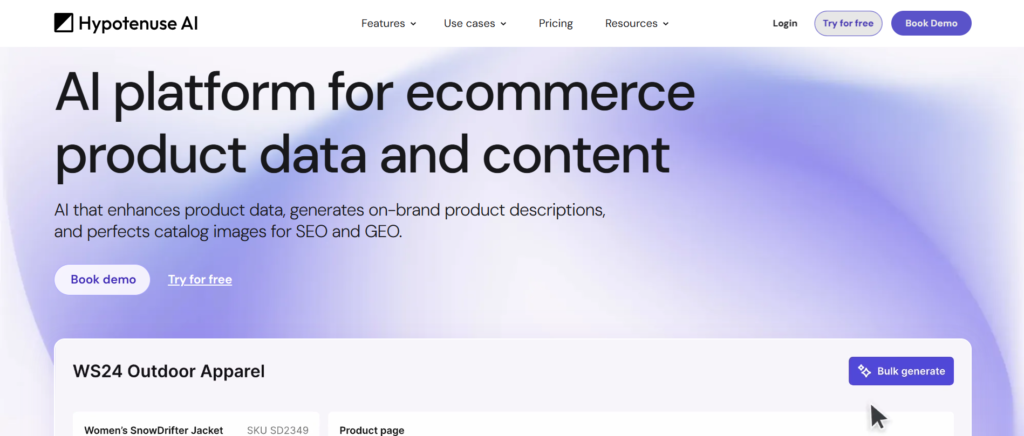
Companies with extensive product catalogs often face the challenge of creating unique descriptions, marketing copy, and promotional content for hundreds or thousands of items. Hypotenuse AI helps automate this process while maintaining consistent messaging across listings.
Beyond product descriptions, the platform can also generate blog articles, landing pages, and marketing materials that support product campaigns. This makes it useful for ecommerce companies that want to scale content production across multiple channels.
Because of its focus on structured product data and content generation at scale, Hypotenuse AI is often used by retail brands and online marketplaces.
Best suited for:
Ecommerce businesses that need to produce large volumes of product descriptions and marketing content.
Comparison of the Leading AI Copywriting Tools
Each AI copywriting platform has its own strengths, and the best choice often depends on the type of marketing work you do most frequently. Some tools are built for large marketing teams that need brand voice control and collaboration features. Others focus on helping individuals generate content quickly for blogs, campaigns, or social media.
The table below summarizes how the tools discussed above typically fit into marketing workflows.
| Tool | Best For | Key Strength | Typical Use Cases |
|---|---|---|---|
| Jasper | Marketing teams and agencies | Brand voice control and long-form content generation | Blog articles, landing pages, campaign messaging |
| Copy.ai | Startups and small marketing teams | Structured content workflows | Product messaging, marketing campaigns, social media copy |
| Writesonic | Content marketing teams | SEO-focused content generation | Blog articles, SEO content, landing pages |
| Rytr | Freelancers and small businesses | Simple and affordable AI writing | Social media posts, product descriptions, short marketing copy |
| Anyword | Performance marketing teams | Predictive scoring for ad copy | Advertising campaigns, headline testing |
| Content Hub | SEO-driven content marketers | Integration with keyword research | SEO blog content, content marketing workflows |
| Hypotenuse AI | Ecommerce and product marketing teams | Scalable product content generation | Product descriptions, ecommerce marketing content |
This comparison highlights an important point. There is no single AI copywriting tool that fits every marketing situation. Teams focused on long-form content and SEO often prefer tools that help structure articles and research topics. Performance marketers tend to look for platforms that support campaign testing and ad optimization. Ecommerce businesses, on the other hand, need tools that can generate large volumes of product-related content efficiently.
Understanding these differences helps narrow down the options and makes it easier to identify the platform that aligns with your marketing workflow.
How to Choose the Right AI Copywriting Tool
With so many AI writing platforms available, choosing the right one can feel confusing at first. Most tools can generate marketing content, but they differ in how they fit into real marketing workflows. The best choice usually depends on the type of content you produce, the size of your team, and how the tool will integrate into your existing marketing process.
Looking at a few practical factors can make the decision much easier.
Type of content you produce
The first question to consider is what kind of marketing content you produce most frequently.
If your team publishes a large number of blog posts or SEO articles, tools designed for long-form writing workflows tend to work better. Platforms like Writesonic or ContentShake AI focus on helping marketers structure articles and generate SEO-oriented content.
If your work involves advertising campaigns, product messaging, or short marketing copy, tools like Copy.ai or Anyword can be more useful because they generate multiple variations quickly.
Matching the tool to the type of content you create will usually have the biggest impact on how useful it becomes in everyday work.
Team size and collaboration needs
Some AI writing platforms are designed for individual users, while others are built with marketing teams in mind.
Freelancers and small businesses often prefer simple tools that allow them to generate content quickly without managing complex workflows. Tools such as Rytr fit well in this scenario.
Larger teams, on the other hand, may benefit from platforms that include collaboration features, brand voice settings, and shared workspaces. Jasper, for example, is often used by agencies that need consistent messaging across multiple writers and campaigns.
Budget and pricing structure
Pricing models vary widely between AI writing tools. Some platforms charge based on the number of words generated, while others use subscription tiers that unlock additional features.
Before choosing a tool, it helps to think about how frequently it will be used. Teams producing large volumes of marketing content may find value in more advanced platforms, while smaller teams may prefer lightweight tools that cover the basics at a lower cost.
Integration with existing workflows
Finally, it’s worth considering how well a tool fits into your existing marketing workflow.
Some platforms integrate with SEO tools, content management systems, or marketing automation platforms. These integrations can make it easier to move from idea generation to publishing without switching between multiple tools.
The best AI copywriting tool is rarely the one with the most features. It is usually the one that fits naturally into the way your marketing team already works.
Final Thoughts
AI copywriting tools have quickly become part of the everyday toolkit for many marketing teams. They help reduce the time it takes to move from an idea to a draft, generate multiple variations of campaign messages, and support the production of blog articles, landing pages, and marketing content at scale. Used thoughtfully, they can make content workflows far more efficient.
At the same time, the role of the marketer does not disappear. These tools work best when they support human creativity rather than replace it. Marketers still shape the message, refine the tone, and ensure that the final content connects with the audience.
The right tool ultimately depends on how your team works. Some platforms are better suited for long-form content and SEO workflows, while others are designed for advertising campaigns or product marketing. Taking a little time to explore a few options usually helps identify which platform fits naturally into your content process.
As the ecosystem continues to evolve, new tools will keep appearing and existing platforms will expand their capabilities. For marketers willing to experiment and adapt, AI copywriting tools can become a powerful way to produce better content more consistently.
Frequently Asked Questions (FAQs)
Are AI copywriting tools suitable for professional marketing content?
Yes, many marketing teams now use AI copywriting tools as part of their content creation process. These tools are particularly helpful for generating first drafts, exploring different messaging ideas, and producing multiple variations of marketing copy.
However, most teams still review and edit the output carefully before publishing. The tools work best when they support the writing process rather than replacing human judgment and creativity.
Can AI copywriting tools help with SEO content?
Many AI writing platforms include features designed to assist with SEO-focused content. These tools can generate article outlines, expand sections, and help writers structure blog posts around specific topics.
Some platforms also integrate with keyword research tools or provide guidance on search intent, which can make it easier for marketers to produce content that aligns with their SEO strategy.
Do AI copywriting tools replace human writers?
In practice, they usually act as writing assistants rather than replacements for human writers. Marketers often use them to speed up early stages of writing such as brainstorming ideas, drafting outlines, or generating initial content.
Human writers still play an important role in shaping the narrative, refining the tone, and ensuring that the content communicates clearly with the intended audience.
Are these tools useful for small marketing teams?
Yes. In fact, smaller teams often benefit the most because AI tools can help them produce more content without increasing the size of the team.
Freelancers, startups, and small businesses frequently use AI writing tools to create blog articles, social media posts, product descriptions, and campaign copy more efficiently.
How should marketers choose between different AI copywriting tools?
The best choice usually depends on the type of content a team produces most often. Some tools are better suited for long-form blog writing and SEO content, while others focus on advertising copy, product messaging, or campaign workflows.
Testing a few tools with real marketing tasks often provides the clearest sense of which platform fits naturally into your workflow.